How Much to Feed a Dog by Weight: A Real Method
If you came here for a number — "a 50-pound dog eats X cups" — the honest answer is that no single number is right for every 50-pound dog. How much you should feed your dog by weight depends on more than the weight: the calorie density of the specific food in your bowl, whether your dog is spayed or neutered, how active they actually are, their age, and whether they're currently lean or carrying extra. Two dogs the same weight can have daily needs that differ by several hundred calories.
That sounds like a dodge, but it's actually good news. It means you can get to a genuinely accurate amount with about ten minutes of math and a few weeks of paying attention. Here's how.
The short answer
Feed by calories per day, not cups. Work out roughly how many calories your dog needs, find how many calories are in the food you're using, divide, and you have a starting portion. Then watch your dog's body over the next few weeks and adjust. The feeding chart on the bag is a reasonable opening guess, but it's calibrated for an average dog that may not be yours — it tends to run generous, and it can't see whether your dog is already overweight.
So the method is: estimate calories, convert to a portion of your food, then let your dog's actual body tell you whether the estimate was right.
Step 1: Estimate your dog's daily calories
Vets use a two-part formula, and you can run it on any calculator with an exponent key.
First, the resting energy requirement (RER) — the calories a dog burns just existing at rest:
RER = 70 × (body weight in kg)^0.75
To get kilograms, divide your dog's weight in pounds by 2.2. A 50-pound dog is about 22.7 kg. Raise that to the power of 0.75 (use the xʸ key), then multiply by 70. That comes out to roughly 730 calories.
Then multiply the RER by a factor for your dog's life stage and activity to get the maintenance energy requirement (MER) — the realistic daily total. The commonly used multipliers from veterinary nutrition references are:
- Neutered adult: about 1.6×
- Intact adult: about 1.8×
- Active or working dog: 2.0× or higher
- Senior: about 1.4×
- Weight loss (use ideal weight): about 1.0×
- Puppy 4–12 months: about 2.0×
- Puppy under 4 months: about 3.0×
So our 50-pound neutered adult: 730 × 1.6 ≈ 1,170 calories a day. That's the number to feed to, and it includes everything — meals, treats, the crust of toast someone slipped under the table.
One important caveat: these multipliers are estimates, and individual dogs can vary from the predicted value by as much as 50%. The math gets you a sensible starting point, not a verdict. Puppies, large- and giant-breed growth, pregnant or nursing dogs, and any dog with a health condition are genuinely complicated — for those, get the number from your vet rather than a formula.
Step 2: Find the calories in your actual food
This is the step the cups-based approach skips, and it's where most overfeeding hides. Two foods can look identical in the bowl and differ a lot in calories.
On the bag, look for the line that reads something like "kcal/kg" and "kcal/cup." That kcal/cup figure is what you want. Dry foods commonly land somewhere around 300–450 calories per cup, but the only number that matters is the one printed on your bag. If you can't find it, the calorie content is sometimes only listed on the manufacturer's website or available by calling them — worth doing once.
Step 3: Do the division
Daily calories ÷ calories per cup = cups per day.
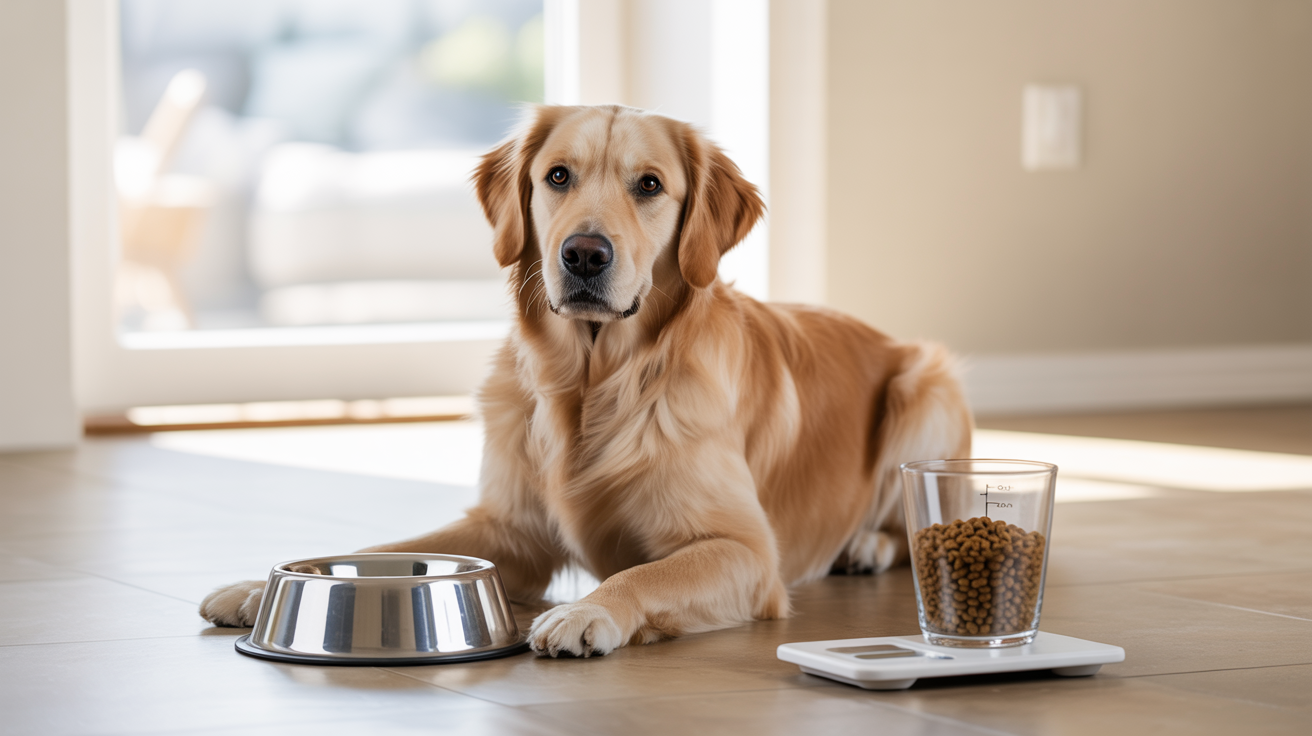
Our example dog: 1,170 ÷ 375 (say the bag lists 375 kcal/cup) = about 3.1 cups a day, split across however many meals you feed. Measure it with an actual measuring cup or, better, a kitchen scale — "a scoop" drifts upward over time, and eyeballing is how a quarter-cup of creep turns into a pound of dog by spring.
If you feed treats, they come out of that total, not on top of it. A good rule of thumb is keeping treats to no more than about 10% of daily calories — for our dog, roughly 115 calories' worth. The rest comes from food.
Step 4: Let the dog's body correct the math
Here's the part the chart can't do. The calorie estimate is a hypothesis. Your dog's body over the next three to four weeks is the experiment.
The tool for reading that is body condition score (BCS) — a 1-to-9 scale vets use to judge whether a dog is too thin, ideal, or overweight. At an ideal score of 4 or 5, you can feel the ribs easily without pressing hard (think the back of your hand), the dog has a visible waist when you look down from above, and a tuck-up in the belly when viewed from the side. If you can see ribs clearly, that's leaning thin; if you can't feel them at all and there's no waist, that's leaning heavy.
Check the body condition every couple of weeks and weigh your dog when you can. If the waist is disappearing and the weight is creeping up, trim the portion by about 10% and reassess. If ribs are getting sharp and weight is dropping, nudge it up. Adjust gradually — a 10% change at a time — and give it a few weeks before judging, because day-to-day weight wobbles mean nothing; the trend over weeks is the signal.
This is exactly the kind of slow-moving pattern that's hard to hold in your head and easy to lose in a notebook. If you log weight and body condition over time — KibbleTrack does this, but a phone note or a spreadsheet works too — you stop relying on "she looks about the same" and start seeing the actual line. A gradual gain that's invisible week to week is obvious across three months of logged weigh-ins.
A rough starting chart (then ignore it)
If you want ballpark daily calories for a neutered adult dog at a healthy weight, before you do the real math:
- 10 lb: ~290 calories
- 20 lb: ~490 calories
- 40 lb: ~830 calories
- 60 lb: ~1,120 calories
- 80 lb: ~1,380 calories
These are estimates for an average, moderately active, neutered adult — not puppies, not seniors, not couch potatoes or marathon dogs. Use them to sanity-check your own calculation, not to replace it.
Common questions
How many times a day should I feed? Most adult dogs do well on two meals a day; puppies need more frequent meals. The total daily amount matters more than how you split it, though splitting helps with hunger and digestion.
Wet food instead of dry? Same method — find the calories per can on the label and divide. Wet food is far less calorie-dense by volume, so the portions look much bigger. If you mix wet and dry, count the calories from each.
My dog acts starving on the right amount. Many dogs would happily eat well past their needs; visible enthusiasm isn't evidence of underfeeding. Trust the body condition over the begging. If a dog at an ideal BCS seems frantic, lower-calorie, higher-volume foods or some added vegetables can help them feel fuller — but check with your vet before reworking a diet.
How fast should an overweight dog lose weight? Slowly, and ideally with veterinary input. Rapid weight loss is unsafe, and dogs that are significantly overweight should be on a vet-supervised plan rather than a DIY crash diet. For weight loss, you calculate from the dog's ideal weight, not the current one — which is one more reason to get that target from your vet.
The takeaway
How much to feed your dog by weight isn't one number off a chart — it's a quick calorie estimate based on weight, life stage, and activity, converted into a portion of the specific food you're using, then corrected over a few weeks by watching your dog's body. The bag's chart gets you in the neighborhood. Your dog's waistline tells you the address.
And when the topic crosses into medical territory — a puppy's growth, an overweight dog's diet plan, a dog with a health condition — that's the line where a tracking method ends and your vet begins.