How Often to Weigh Your Rabbit or Guinea Pig
Weigh your rabbit or guinea pig once a week, on a kitchen scale that reads in grams, at roughly the same time of day. That's the short answer to how often you should weigh a guinea pig or rabbit, and it's worth doing even when your animal seems perfectly fine — because with these species, the weekly number often spots trouble before anything else does.
Here's the thing most new small-pet owners don't realize: rabbits and guinea pigs are prey animals, and prey animals are wired to hide weakness. A sick rabbit acts normal for as long as it possibly can, because in the wild, looking sick gets you eaten. By the time a rabbit or guinea pig visibly seems unwell, the problem is often well advanced. A logged weight trend cuts through that instinct. The animal can hide its illness from you; it can't hide it from the scale.
Why weekly, and why it matters more than for a dog
With a dog or cat, weight is one useful health signal among many — you can read a lot from their energy, appetite, and behavior. With rabbits and guinea pigs, those behavioral signals show up much later, so a gradual weight change is sometimes the only observable sign that something's wrong. That flips weighing from a nice-to-have into one of the most important things you do.
Weekly is the cadence vets and rescues consistently recommend for healthy adults. It's frequent enough to catch a downward trend early, but not so frequent that normal day-to-day wiggle drowns out the signal. A weekly number, logged over months, draws a line you can actually read.
Two situations call for more often:
- Growing youngsters. Animals under about six months are still gaining; weigh them more frequently so you can confirm steady growth.
- A sick or recovering animal, or one that's gone off its food. If your pet is ill, not eating, or you're hand-feeding, switch to daily — sometimes more — so you can track the situation in close to real time. This is also exactly when the trend matters most.
How to weigh a squirmy small animal
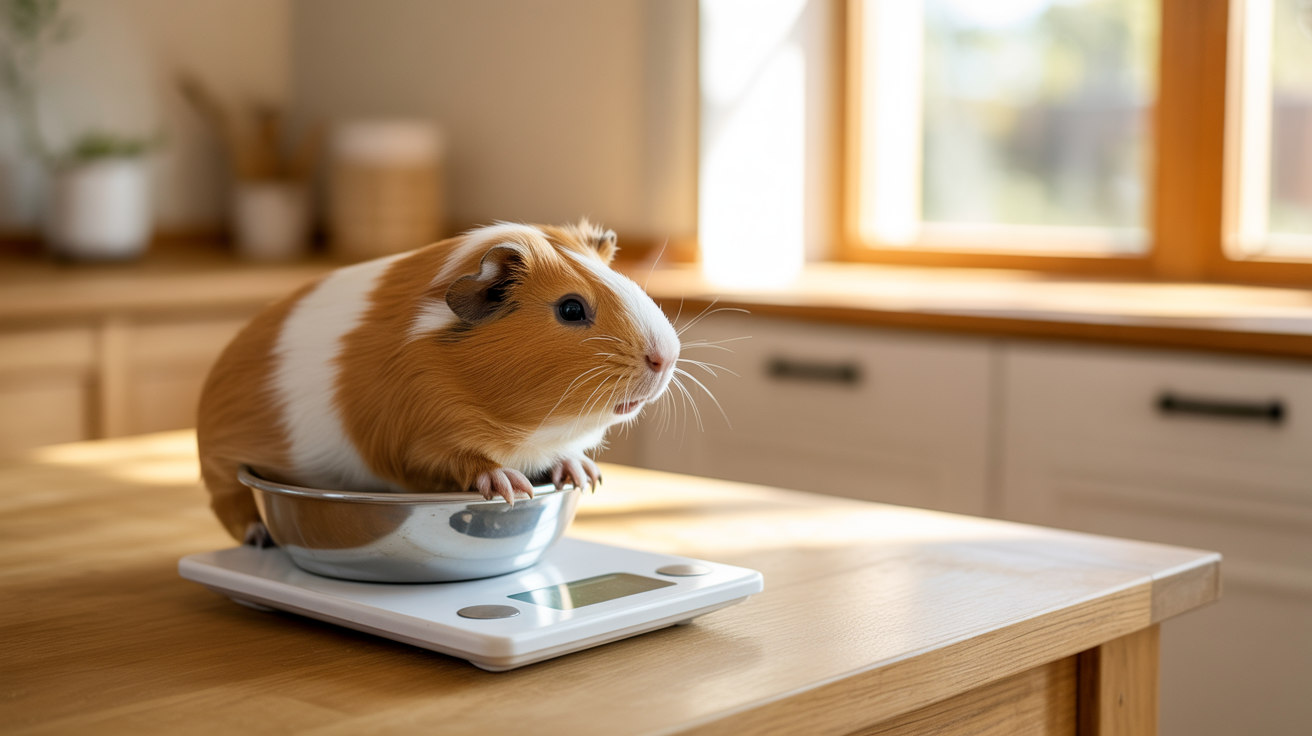
You don't need special equipment. A digital kitchen scale that reads in grams does the job, and grams matter here — a scale that only shows pounds and ounces hides exactly the small changes you're trying to catch.
The method:
- Put a small open box or bowl on the scale — something your pet can sit in.
- Tare the scale (zero it out) with the box on it, so you're only measuring the animal.
- Set your pet in the box, wait for them to settle, and record the reading.
- Keep the scale low to the ground or on a stable surface — a startled guinea pig can launch, and you don't want a fall.
Weigh at a consistent time, ideally before the morning feed. A full gut adds weight, so a pet weighed right after breakfast reads heavier than the same pet weighed before — keeping the timing consistent removes that noise. Record the number in grams every single time, even when it's boring and unchanged. The boring weeks are what make the alarming week obvious.
What counts as a normal wobble versus a real change
Not every dip is a crisis. Weight fluctuates a little with digestion, hydration, and recent meals — a guinea pig can drop a few tens of grams just from a recent bathroom trip. Small ups and downs in the range of roughly 5 to 20 grams are usually just the ordinary churn of eating and eliminating, not a health signal.
What you're watching for is a trend — a steady drift downward over weeks, or a sudden meaningful drop — and a change that doesn't have an obvious reason behind it. If you haven't changed the diet or routine and the weight is sliding, that's the signal to pay attention.
The clearest threshold the experts agree on: a loss of around 10% of body weight, whether over one week or creeping across several, is a reason to see an exotic vet even if your pet shows no other symptoms. For a 1,000-gram guinea pig, that's 100 grams. For a 2-kilogram rabbit, it's 200.
For guinea pigs specifically, longtime keepers use a quick ounce-based rule of thumb between weekly weigh-ins:
- 1 ounce (~28 g) of fluctuation: normal, no worry
- 2 ounces (~57 g): go on alert, start watching closely
- 3 ounces (~85 g): treat as a red flag
- 4 ounces (~113 g): get to a vet
Treat these as guideposts, not gospel — they're a sensible framework, but a small female guinea pig and a large male aren't the same animal, which is exactly why the percentage-of-body-weight view is the more reliable lens. And any weight loss combined with reduced appetite is worth a prompt call regardless of the number.
Pair the scale with a hands-on check
The number on the scale is most useful alongside a quick body check, because an animal can hold steady on the scale while slowly losing muscle and gaining fat — or the reverse.
Run your hands gently along your pet's body, from behind the ears down to the rump. On a well-conditioned rabbit or guinea pig you should be able to feel the ribs and spine with light pressure, covered by a modest layer of padding — not jutting out, not buried. If you can feel bones sharply without trying, your pet is likely too thin; if you can't find them without really pressing, likely too heavy. Do this check every week or two alongside the weigh-in, and you've got both halves of the picture.
A note on senior animals: older guinea pigs and rabbits sometimes "slim down" in body condition without the gram count changing much, as muscle gives way. That's one more reason to look and feel, not just read the scale.
Keep a record, not just a memory
A single weight is nearly useless. A weight today only means something next to the weight last week and last month. The entire value of weighing is in the series, which means you have to write it down — every reading, with the date.
This is the part that quietly fails. People weigh diligently for a month, skip a few weeks, and then can't answer the one question the vet asks: "How much weight, over how long?" Without the history, you're guessing.
Use whatever you'll actually keep up with. A notebook by the cage works. A spreadsheet works and has the bonus of plotting a graph, where a slow decline jumps out far more clearly than a column of numbers. A tracker like KibbleTrack will log the weights and chart the trend for you, and if you keep more than one animal, it keeps each one's record separate — which matters more than it sounds, because mixing up which guinea pig weighed what defeats the whole purpose. The tool is less important than the habit. One place, every week, with dates.
And when something does look off, that record becomes genuinely valuable: walking into the vet with twelve weeks of logged weights gives them a head start on the diagnosis that "she seems a bit thinner lately" never could.
When to skip the wait and just call the vet
Weighing is for catching slow trends. Some things shouldn't wait for the next weigh-in. With rabbits and guinea pigs, get to an exotic vet promptly — not at the next weekly check — if your pet stops eating or stops producing droppings, refuses foods they normally love, seems lethargic or hunched, or shows a hard or bloated belly. In these animals, not eating is an emergency in its own right, because their digestive systems are built to keep moving constantly.
This article is about monitoring, not diagnosis. The scale tells you that something may be changing; it can't tell you what. That part is a conversation with a vet experienced in small mammals — and finding one before you need them is worth doing now rather than during a 9 p.m. scramble.
The takeaway
Weigh your rabbit or guinea pig weekly, on a gram scale, before breakfast, and write down every number with the date. Watch the trend rather than any single reading, pair the scale with a hands-on body check, and treat a loss of around 10% of body weight — or any weight loss alongside a dropping appetite — as a reason to see an exotic vet, even if your pet otherwise seems fine. For animals that are built to hide illness, that weekly number is the closest thing you have to a heads-up, and it costs you about thirty seconds a week.